Audeze Maxwell 2 | Sidegrade, but still Amazing
Amazon links in this article are affiliate links. As an Amazon associate, I earn from qualifying purchases.
Quick Summary
The Audeze Maxwell 2’s planar magnetic audio drivers make it one of the best choices for FPS games. However, the weight is insane and the sub-bass is very limited. I recommend these for fans of planar drivers, but others will be disappointed.
Here’s the tl;dr:
Excellent detail + sound separation for shooters
80 hour battery life
Decent boom mic, great noise cancellation
Weak sub-bass and bass
Incredibly heavy (562 grams without the mic and 574 with it)
No simultaneous dongle + Bluetooth
Maxwell vs Maxwell 2: what actually changed
What’s better
Larger and softer pleather pads that are magnetically detachable
Includes a much improved wider headband option (less top pressure)
Boom mic is significantly better after updates
Replaceable faceplates
What’s worse
Heavier: my Maxwell is 502g/514g (with/without mic) and my Maxwell 2 is 562g/574g (with/without mic)
Partial swivel instead of 90° (I don’t really miss it)
Constant white noise/hiss even with no audio playing
Less bass quantity than the Maxwell 1
There is still no simultaneous dongle + Bluetooth audio and the weight went up 14%, not down. Since the original Maxwell’s two biggest weaknesses didn’t get improved, I ultimately just consider this a sidegrade.
Connectivity options
I bought the PlayStation version at launch. It works with PC and Switch 2. Game/chat mixing works perfectly on PC, but it doesn’t work on PS5 due to Sony’s limitations. I don’t have the Xbox version yet. An active noise cancellation version has been announced, but the launch units do not have ANC.
The Maxwell 2 can be used with the USB-C wireless dongle, USB-C wired, 3.5mm wired, and Bluetooth. Below is an image that explains all the connection options from Audeze’s website:
There is no simultaneous dongle + Bluetooth audio. It prioritizes Bluetooth, so after your Bluetooth device stops playing audio for a few seconds, it switches back to dongle audio automatically. There’s no manual swap control.
Range has been mediocre for me: roughly 10–12 feet.
Battery life
Audeze claims up to 80 hours, and in my use it’s believable. I’m only draining around 20% a week.
Controls
Right Earcup
power (also answers/ends calls)
Bluetooth media play/pause
mic mute switch
Left Earcup
volume wheel (press to enter EQ mode to cycle presets, press again for track mode)
game/chat mixing wheel (press to switch that wheel into sidetone control)
mic noise reduction button that toggles off/low/high
Ports are simple: 3.5mm and USB-C, plus the detachable boom mic.
Headphone Audio Quality
Measurements taken with my miniDSP EARS (not industry standard).
The Maxwell 2 uses 90mm planar magnetic drivers like the original Maxwell with a frequency range of 10 Hz - 50 kHz. They have a max bit rate of 24-bit/96 kHz.
These have very fast transient response, excellent separation, and it stays crisp when a match gets chaotic. Footsteps are easy to pick out, and never gets muddy or muffled when explosions and low-frequency chaos stack up.
The soundstage isn’t the widest thing out there, but it’s still more spacious than most gaming headsets.
The tradeoff is bass quantity. Compared to headsets like the Astro A50 Gen 5 or even the PC38X, the Maxwell 2 just doesn’t have much low-end weight. That helps it stay “competitive”, but it’s less satisfying for immersive games and music.
The default tuning is also sharp and very fatiguing in the treble. There’s a generally metallic timbre that you cannot remove with equalization.
Audeze pushed an update (1/22/2026) that changed the sound slightly, and I measured pre-patch vs post-patch back to back. The patch added a hint more sub-bass. The rest of the curve stayed very similar.
Where this mattered most for me was Call of Duty. In CoD, when someone is above you, footsteps often shift to a lower pitch to mimic muffling through floors and surfaces, and that cue becomes more thumpy. With the Arctis Nova Elite, I can physically feel that sub-bass thump more.
Switching back and forth, that’s one reason I actually had an easier time with the Nova Elite for competitive play, even though the Maxwell 2 has impressive detail.
Black Ops 7 with the Maxwell 2
Metroid Prime 4 with the Maxwell 2
If you’re not exclusively an FPS player, the sub-bass limitation shows itself more. You can hear extra bass texture, but the lowest frequencies are too quiet in the mix to feel powerful. Despite the “SLAM” branding, it doesn’t slam in the sub-bass the way I want. It can hit hard in certain higher bass / lower-mid impacts, but deep rumble like wind and thunder takes a back seat and can come across higher pitched than it should.
One big win: the Maxwell 2 takes equalization extremely well without distorting. You can boost it aggressively and it generally stays composed.
In short, these are an excellent choice for competitive shooters, but that’s all I’d really use these for.
Microphone Quality
At launch, the Maxwell 2 mic was rough and sounded quite compressed. It’s been improved with the Jan 22, 2026 update. It’s not as full and clear as the Astro A50, but it’s respectable.
Noise reduction is the standout feature. Even with it off, it reduces some background noise. Low does a great job with keyboard typing. High can seriously suppress something loud like an arcade stick. The catch is stronger noise reduction boosts and processes the signal more.
Beamforming / integrated mics
When you take out the boom mic, it switches to the internal ones. The integrated mics are convenient, but the sound is pretty terrible. They pick up more room reflections and sound extremely tinny without the noise reduction on. If you care about quality, you’ll want the boom mic. If you care about convenience, they’re usable.
Software
The software also got improved after launch.
You get game/chat mixing (with exact percentages), sidetone control, voice prompt volume adjustment, auto shutdown timing, and a working 10-band equalizer. Settings save to the headset, and whatever you set carries over to Bluetooth too.
Comfort and Build Quality
The new pads and wider headband help a lot. The pads seal well and feel properly over-ear. Glasses wearers like myself won’t have any problems.
The new headband is annoying to install at first because you have to break in the holes, but it gets easier, and it’s worth it for the better weight distribution.
But the weight itself is still absurd. Here’s some quick context with weights of a few of my other devices:
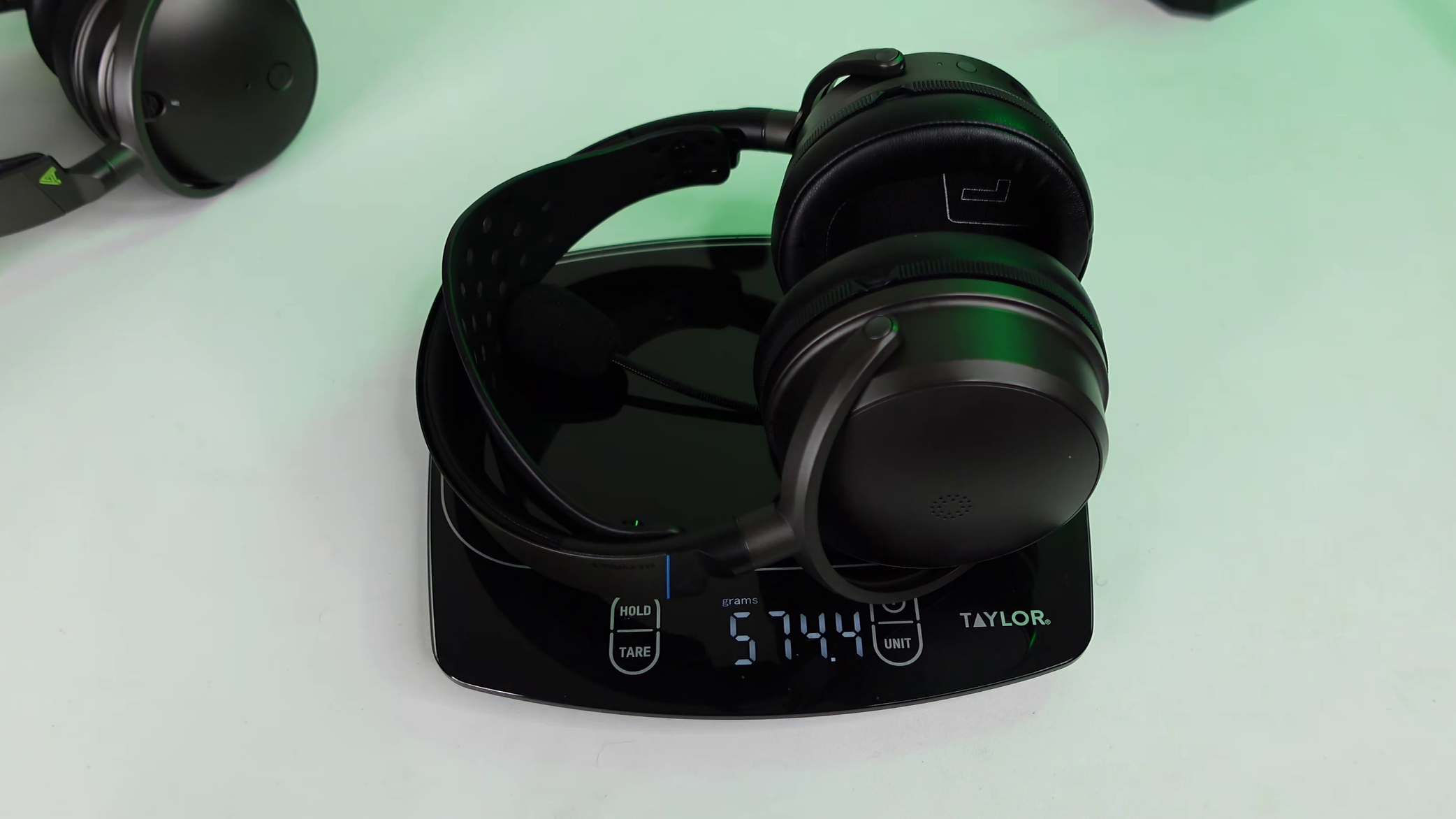
Maxwell 2: 562g no mic / 574g with mic
Astro A50 X: 369g
Arctis Nova Elite: 379g
HyperX Cloud (with mic): ~300g
Sony ULT Wear: 255g
Realistically, I can wear the Maxwell 2 for about an hour and a half before I need a break. Build quality seems good so far, but long-term durability is still something we’ll only know with time. Unlike most headsets, the frame length cannot be adjusted, only the suspension headband.
Verdict
If you want maximum FPS detail and separation above all else, get the Audeze Maxwell 2.
However, it’s still missing simultaneous dongle + Bluetooth, it’s even heavier than the original, and the sub-bass isn’t physical enough for immersive gaming and music. So for most use cases, it’s not my top pick.